
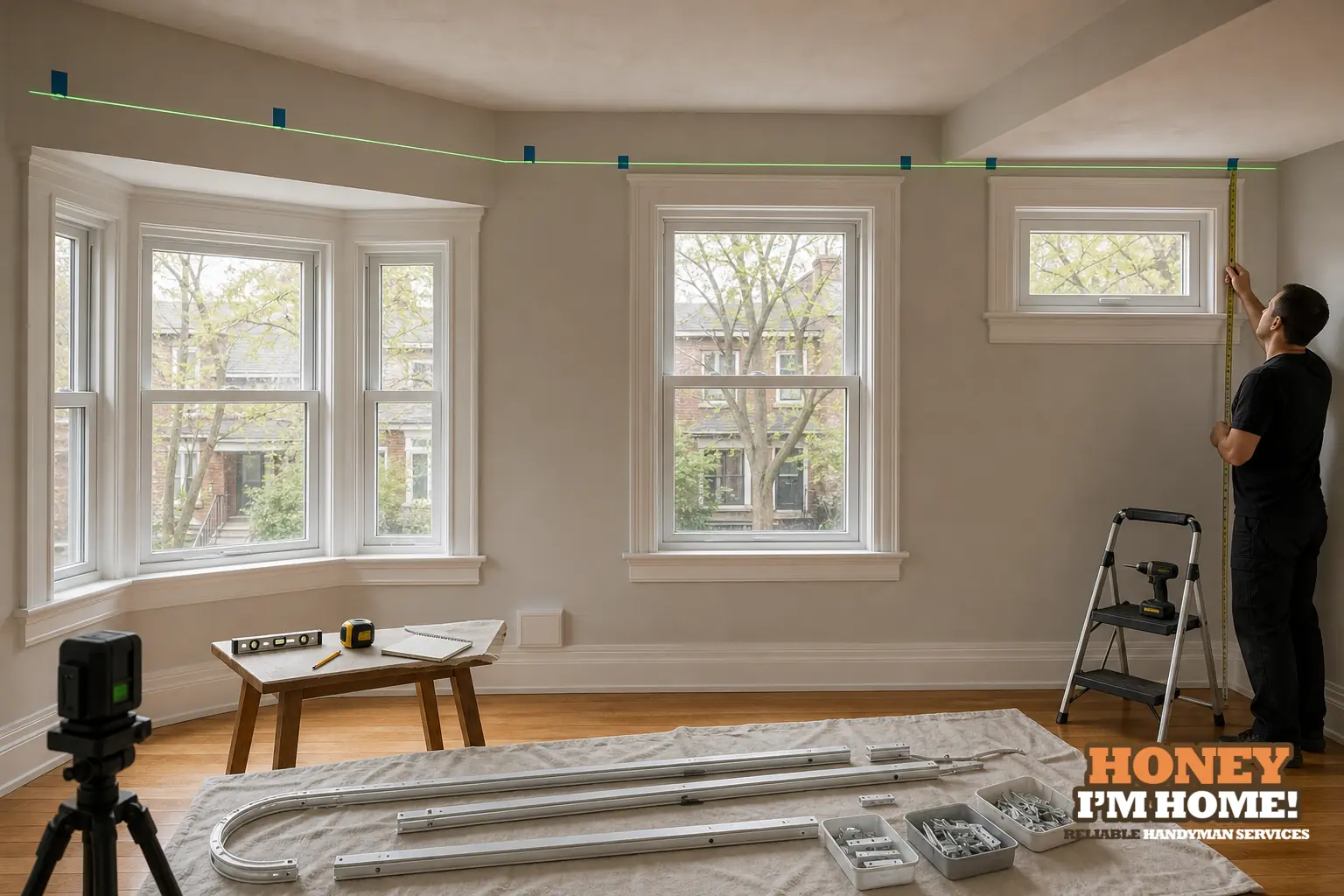
Start by surveying the visible finish and the underlying assembly, pick a mounting plane (ceiling or wall) that clears trim and obstructions, locate secure fixings, and plan track centres so curtains clear trims and hardware. I check for earlier renovations, dropped soffits, and junctions where finishes change before committing to a single continuous line.
I write this from years of fitting tracks in occupied houses across the city. When a homeowner asks me to plan alignment I work methodically: I look for how the room was finished, where the structure will actually take a fastener, and what the curtains must clear in everyday use. In this guide I’ll walk through the inspections and decisions I make on site so you can talk specifics with your fitter or measure confidently before ordering a track.
Start with a careful survey of the assembly
The visible trim and paint tell only part of the story. I peel that back with a few quick checks: probe for solid timber behind the finish, look for plaster or drywall joints, and inspect above the head of the window for soffits or droops. If you have a cornice, deep casing or a built-up header, the mounting plane may sit away from the window face. I won’t assume a painted wall equals a stud close behind it — older houses and later additions often hide layers of finish.
On every job I examine the ceiling and the top of the window reveal. If the ceiling is interrupted by a boxed-in beam, a shallow dropped soffit, or a visible service chase, that changes whether I choose a ceiling mount or a wall mount. I also check the return on the curtain side: tight returns and thick casing can push a fabric away from the window if the track sits too close to the frame.
Choose the mounting plane and plan clearance
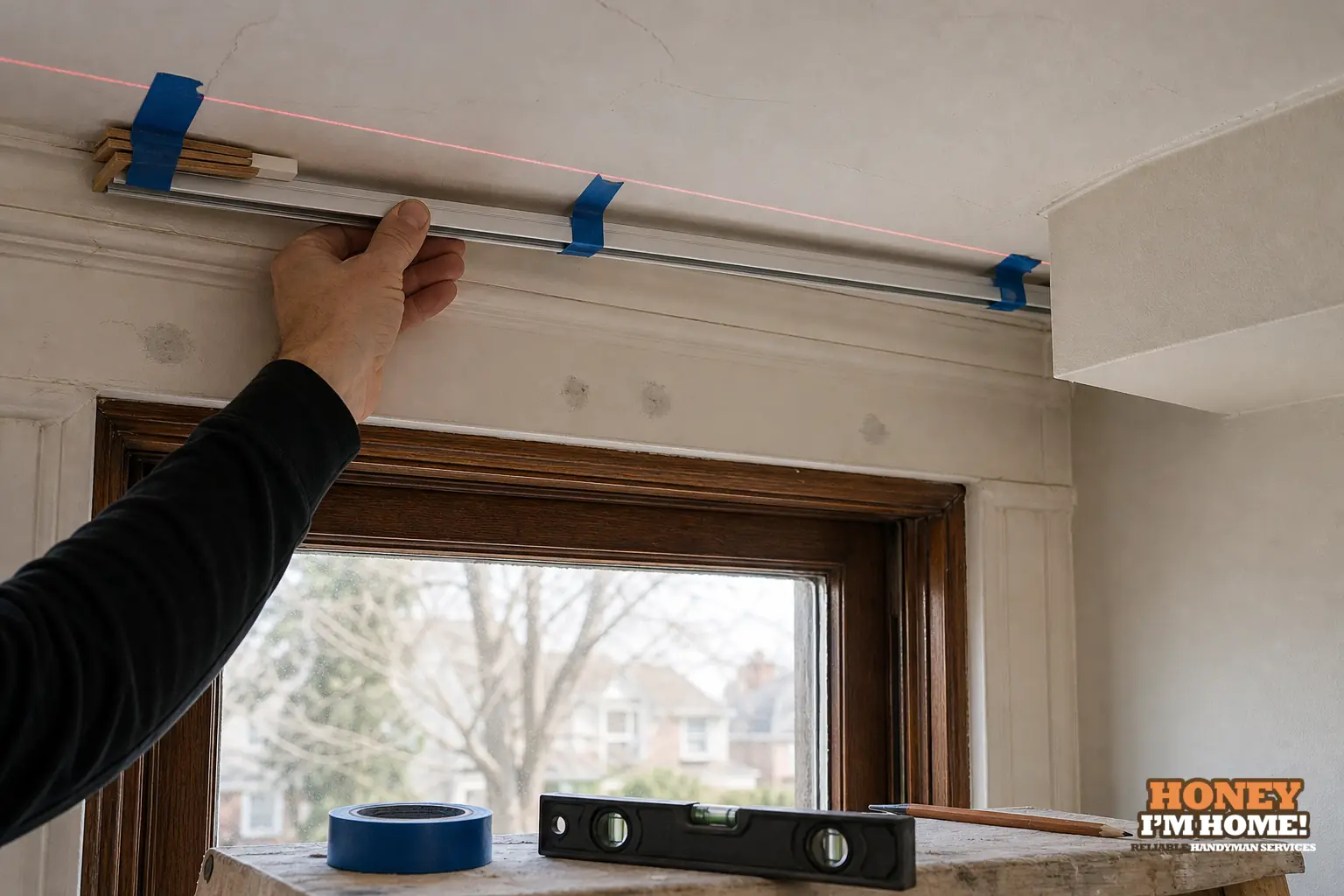
Deciding to mount on the ceiling or the wall is the single biggest alignment choice. A ceiling mount keeps the curtain closer to the window head when the ceiling is flat and solid, but it becomes awkward under low or irregular soffits. A wall mount provides easier placement around cornices and deep casings, and it lets me drop the track below a ceiling reveal when the upper finish is fragile.
I plan the track so the curtain hangs clear of casings, handles and any operable parts like crank arms. Where a window opens into a balcony or there’s an external shutter, I visualise curtain travel — will the curtain stack to the side cleanly? I won't specify fixed overlap dimensions here, but I always confirm there’s enough fabric clearance at the edges and that the bottom of the curtain won’t catch on a radiator cover or an interior ledge.
Locate solid fixing points before you mark a continuous run
Continuous aluminium or steel tracks need regular supports. Instead of marking a centreline and drilling immediately, I find studs, blocking, or ceiling joists with a reliable scanner and by small exploratory exposes if finishes allow. In hollow plasterboard ceilings I plan for anchors designed for that substrate. When the structure runs crosswise to the window, I choose a combination of long-span brackets and intermediate ceiling anchors to prevent sag and to keep the track straight for smooth gliding.
On-site I also check for uneven plaster and warped timber. If the ceiling surface tilts or the wall undulates, the neatest-looking solution is often to set the track on adjustable brackets or to use a straight rigid carrier that can be shimmed. That avoids having curtains pull to one side because the track followed a visible high or low spot in the finish.
Managing transitions: casings, picture rails and boxed-in details
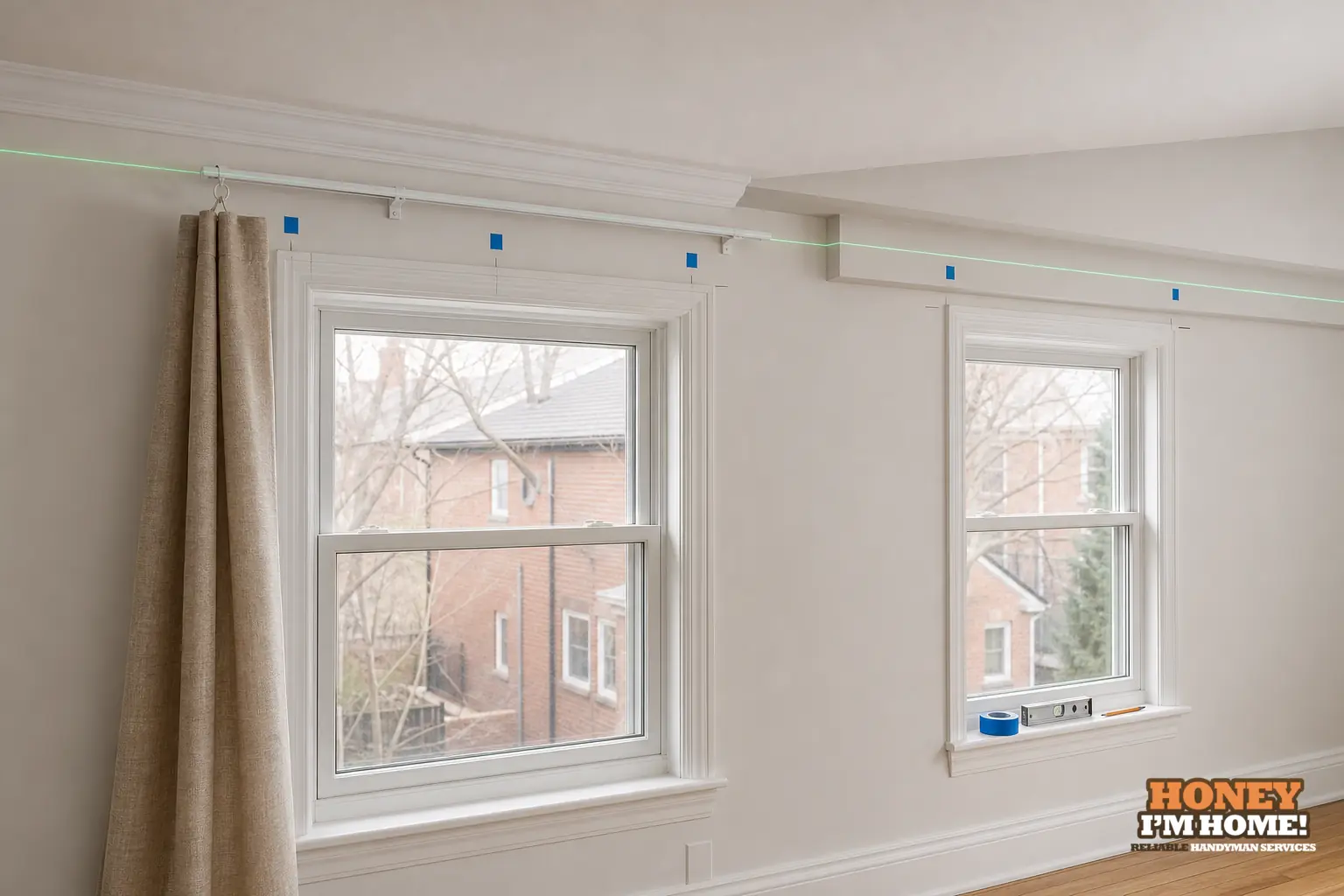
Older homes and some renovations have picture rails, deep casings, or boxed-in headers. Those details can be architectural highlights — and obstacles. I decide whether to align the track with the picture rail line, run over the casing, or drop below it. That decision is usually driven by how the curtain needs to travel and what looks visually balanced with the room mouldings.
If a casing is deep enough to prevent the curtain from clearing the window, I either move the track out further from the face of the wall or choose a bracket that places the track a short distance forward. For boxed-in headers where fixing into a solid surface is possible, I favour using the boxed-in member as a positive fixing point rather than trying toggle anchors into a thin ceiling finish.
Tie the plan back to how the house was built in your neighbourhood
In The Queensway many properties are older: the City’s 2016 Stonegate-Queensway profile shows a majority of dwellings were built before 1960 and that more than half are single-detached houses. That means I frequently work in rooms with several generations of finishes — layers of plaster or multiple skims — and I meet later additions where floor levels and casing profiles change. Those conditions make a pre-install survey essential.
Practically, that neighbourhood character alters three on-site decisions I make: I check for hidden blocking behind thick finishes rather than assuming studs are where the modern layout suggests; I measure reveal depth and the interface of old casing to newer drywall so the curtain hangs without binding; and I prepare for uneven ceiling planes by planning adjustable supports. Where a room clearly shows a later addition, I inspect the junctions closely because they’re often where the mounting plane steps or where the ceiling height changes.
How I measure and mark without committing too early
When I’m on site I sketch a simple elevation of the window and mark visible obstructions. Then I test a few bracket positions with small temporary screws or clamps so I can see how the curtain will sit when drawn. That stage is where misalignments get avoided: a rail drawn on paper can miss a cornice depth or an overhanging soffit. By physically checking, I can shift the track forward, back, or below a feature before anything is cut or permanently fixed.
I also verify the path of the curtain between tracks on adjacent windows. If two windows sit on the same wall but have differing casing depths or sills, I plan a continuous track only if one mounting plane will work across the whole length. Otherwise, I plan for separate tracks with a visually consistent drop and stack position so the curtains appear intentional rather than shoehorned.
Practical field checks I always do before final fixing
- Verify the track is level across its full run with a straightedge or spirit level.
- Confirm each planned bracket hits solid backing or use an appropriate hollow-wall anchor where needed.
- Check that curtain carriers glide freely past a test obstruction where casings meet the track line.
- Test a curtain sample or prototype stack to ensure the fabric clears handles and interior trims.
- Reassess where a cornice or picture rail forces the track into a secondary plane; plan for aesthetic trim to hide bracket heads if necessary.
Those checks are simple but they catch most alignment problems before holes are drilled.
If you’d like a practical, in-home assessment I’ll come measure the assembly and discuss the trade-offs. See our service overview at Curtains, Blinds & Window Coverings and book an estimate at Contact Russ.
Can I mount a continuous track across a room with different ceiling heights?
I assess the steps and transitions first; sometimes a continuous track works if adjustable brackets are used, other times separate tracks with matched drops look cleaner.
How do I know the ceiling will hold the track where I want it?
I locate joists or blocking and test with small fasteners; if solid backing isn’t present I specify anchors suited to the ceiling finish.
Will the curtain clear older casings and deep mouldings?
I measure reveal and casing depth then set the track forward or choose brackets so fabric clears mouldings when drawn.